Who does the work.
A small firm, deliberately. The people who ran expert research before AI, running it again with better instruments.
Russ W. Rosenzweig founded Vista Research and chairs it. In 1994 he helped build one of the world’s first expert networks, and in doing so helped create an industry that is now measured in billions. He has spent the three decades since on the same problem from every side of it: convening specialists, screening them, and turning what they know into something a decision-maker can act on.
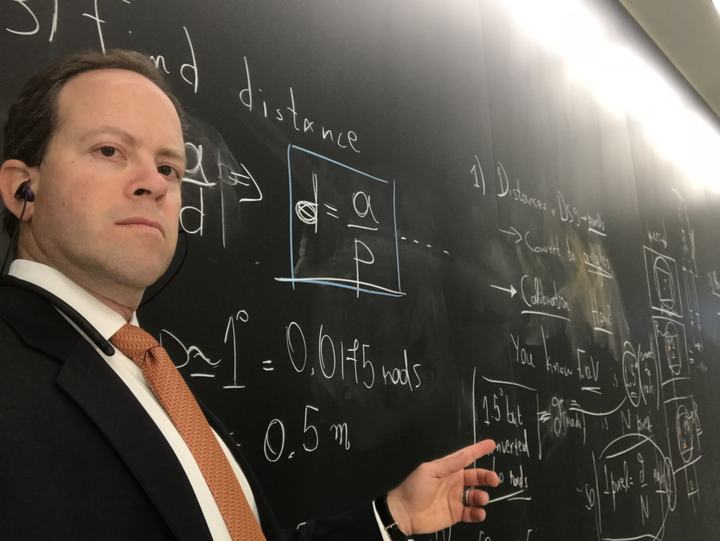
His training is mathematical. He studied in Northwestern’s Mathematical Methods in the Social Sciences program from 1989 to 1993, where his game theory professor was Roger Myerson, later a Nobel laureate, and took his MBA at the University of Chicago Booth School of Business. Across those years he studied under seven Nobel laureates; the seventh, Joel Mokyr, was named in 2025, after he wrote in his book that not one of the first six had given him an A. Why he now writes with AI: Time Regained. The models they taught, and those built on them since, fill The Library: 232 entries, each written out with its mathematics, its sources and where it breaks. Every one of our Research shows how its figures were made.
He is based in Chicago. Vista Research is operated by Arete & Associates, LLC, an Illinois company.
Read the full transcript
Lightly edited for readability.
I'm Russ W. Rosenzweig, and welcome to the new Vista Research, relaunched right now, in September of 2026, in the post-AI era. So what is Vista Research? We help investors and executives make better decisions, period. And we do it via primary research.
Indulge me for a moment in a brief origin story, slash bio. It was 32 years ago, in the freezing cold winter of 1993 and 1994, in Evanston, Illinois, when I was attending Northwestern University, that I formed a company called Round Table Group, which was arguably the first expert network. Maybe the second, if we count the Delphic Oracle, which did actually inspire the creation of Round Table Group.
In the 1990s, I was having so much fun starting and growing this amazing expert network. We had two branches, essentially, back then. One focused on expert witness referrals and introductions to litigators. The other branch ran expert phone calls for investment managers. And here's what happened. The expert witness part of our operations is still going strong after 32 years. Round Table Group is still here, and I recently wrote the book about our exploits in the world of expert witnessing and our pioneering work in the modern era of expert witness referrals and engagements. The phone calls part, in which we helped investment managers talk to experts before they made their investment decisions, only lasted a few years.
And here's why. The business grew really fast. It was pretty innovative to be among the very first primary research organizations for investment managers, and the machine we built was essentially selling phone calls. You pay for an hour with a stranger who, I would hope, knows a lot about the nuances of the investment decision you're weighing. And the more phone calls, the better for us. The meter runs. And the experts' opinions, their thought patterns, the actual work of getting from a conversation back to your investment hypothesis, that stays with you. All we do is organize the phone calls, and you do the investment hypothesis work. The bigger we got, the more subscriptions we sold. Back in the 90s: 50,000 bucks for 50 phone calls per year, I used to literally shout on the phone to our beloved clients.
Lo and behold, primary research for investment managers became a multibillion-dollar industry. Even our namesake, Vista Research 1.0, was acquired by private equity. GLG was acquired by private equity, and every other primary research company was acquired by private equity. I consulted and advised many of them after we stopped providing this service.
I've been waiting for years, for decades, to reinvent primary research for investment managers. I could never really build the kind of primary research company I've always dreamed of, one that goes beyond just setting up phone calls for investors, until now, until the incredible age of AI. I never really thought an hour on the phone with an expert was that great of a product in the first place. But the magnificent era of AI has allowed us to invent a new, pioneering way of doing primary research for investment managers, and even for executives who are contemplating complicated decisions.
So I think things should change now that AI is here. I think an investor should have more options than just phone calls with experts. I'm an investor myself. I also happen to run the world's smallest family office, and I'm its chief investment officer. When I'm trying to put real money behind an investment hypothesis, I don't need another phone call with an expert. I love experts, it's been my life's work, but I just want the answers. I want experts actually contemplating my theories. I want to know from multiple experts: what do they think of our idea? On which parts do they agree? Where do they diverge? What would change their minds? And I don't want to spend my time with a vendor figuring out when those phone calls take place, and having to take notes, and that whole thing. I would rather have an organization that can interview these experts for me, summarize their thinking, add any secondary research, anything publicly written about the topic, and synthesize it. And that's what Vista Research now does in the world of AI.
So give it a try. Come check it out at vistaresearch.ai. I think you're going to like it, because I've been building this in my mind for 30 years and it has finally become a reality. You just bring your investment hypothesis or your business decision and describe it to our fairly brilliant AI concierge. The concierge is going to engage with you about your investment hypothesis or your executive business decision, and really help you hone and refine and perfect the right approach. Then we find you the exact right experts and operators, and we interview them for you, following your own script or request. We save you all that time and phone coordination, and we pair it with very rigorous secondary research and turn it into a synthesized, written report that summarizes the experts' opinions and includes the research findings. And you still get to talk to the experts afterwards if you want. That's a part of the program.
There are no subscriptions. I don't have to sell you 50 calls a year like I used to 30 years ago. Every engagement is just a simple fixed fee, most typically $10,000 to $15,000. We need about three days to a maximum of two weeks to conduct the interviews, conduct the research and deliver the research product to you.
I really think you're going to like it. I think it's better than expert calls alone. I'd love for you to give the Vista Research Desk a try and give me your candid opinion. Go to vistaresearch.ai. I'm really proud of the AI intake desk that we built with very cutting-edge technology. It can really get to the nuances of the challenge or problem or investment decision you're facing. It cites literature, and it even begins the process of figuring out which experts we can pull together for you.
Again, I'm Russ W. Rosenzweig, very proud co-founder and CEO of Vista Research. I think you're going to like this new version of primary research in the AI world. Thank you.
- Prior work.
- Our people have convened panels of faculty from Harvard, MIT, Berkeley, Carnegie Mellon, NYU and Northwestern for Fortune 500 engagements: multi-month portfolio and innovation studies running to eighteen named academic contributors. That is the standard of person we can put in a room, and the reason we are comfortable promising it.
How an engagement is staffed
Every engagement is led by a Research Director, a senior person who scopes the question, recruits and screens the Advisors, runs the interviews, and writes the synthesis. The Desk finds candidates and reads the record. It does not conduct the interviews and it does not write the brief.
Research Directors are engaged per project rather than carried as standing overhead, which is how a firm this size can put genuinely senior people on a question that lasts three to ten days. Every synthesis is reviewed by a second reader before it reaches a client. The brief is checked by someone who did not write it.
The standard behind a match
Vista draws Advisors from two populations, and holds each to a different, verifiable test.
Published authorities qualify on the record: peer-reviewed work that bears directly on your question, with citation history we can show you. Operating practitioners qualify on documented role and tenure: the plant manager, the category buyer, the regulator, the fab operations lead. Many have never published a paper and never needed to.
Vista’s expert network includes 9,200 screened Advisors in the Society of Industry Leaders, every one of them attached to evidence we can produce on request, and a broader network of 275,000 available experts from 32 years in the expert network business. But most of the time the perfect expert is in neither group. We undertake rigorous research on every engagement to find the best and most qualified experts for the question, regardless of whether we previously knew them.
What we will tell you
If your question is better served by a one-hour call, we will say so and name the firms that do it well. If it needs a standing team for six months, we will say that too. We publish our price range, we publish our method in full, and every entry in The Library says where that method breaks.
That is not modesty. It is the only durable way to sell research: be the firm whose reports you can check.